Our first production run was completed! You may now ORDER A UNIT
Easy to wear
AirMax is extremely miniaturized, and weighs only a few grams. It is applied over the nose easily.
An X-ray of night-time respiration
Irregular or disrupted breathing (2-channel Airflow)
AirMax captures airflow from each nostril independently, tracking breathing
patterns including periods of reduced or paused airflow.
These patterns may correlate with restless sleep, frequent waking, morning
headaches, and daytime fatigue.
Heart rate and variability (PPG)
A light sensor detects your heart rate and heart rate variability, showing
how your autonomic nervous system responds during rest. Heart rate patterns - like
slowing down during breathing pauses then spiking upon resumption - may correlate
with breathing variations, while HRV patterns may correlate with recovery quality,
stress levels, and sleep effectiveness.
Blood oxygen variability (Red/IR PPG channels)
Unlike traditional pulse oximeters that heavily average readings, AirMax's
proprietary algorithm calculates oxygen saturation beat-by-beat while
flagging unreliable data from motion or noise. Measuring at the nasal ala
(nostril) captures oxygen changes faster than finger-based sensors, revealing
transient fluctuations that may otherwise be missed, and correlate with breathing variations, sleep
quality, and morning grogginess.
Restlessness and head position (accelerometer)
A precision accelerometer tracks movement, arousals, and head tilt during
sleep. Frequent movement may indicate disturbed sleep that could improve with
dietary or lifestyle changes. Head position tracking helps identify if
breathing irregularities occur primarily in certain positions - whether on
your back, side, or stomach - revealing which sleep postures to potentially avoid.
Snoring and environmental sounds (microphone)
AirMax maximizes your phone's microphone sensitivity and records peak sound
levels to capture snoring intensity and ambient noise like traffic, HVAC
systems, or household disturbances. Loud or persistent snoring may correlate with
breathing variations, while environmental noise may correlate with
fragmented sleep and frequent awakenings.
Room illumination (light sensor)
AirMax leverages your mobile phone's ambient light sensors to record the level of luminosity of the room.
Too much light during the night or early morning can interfere with natural sleep rhythms.
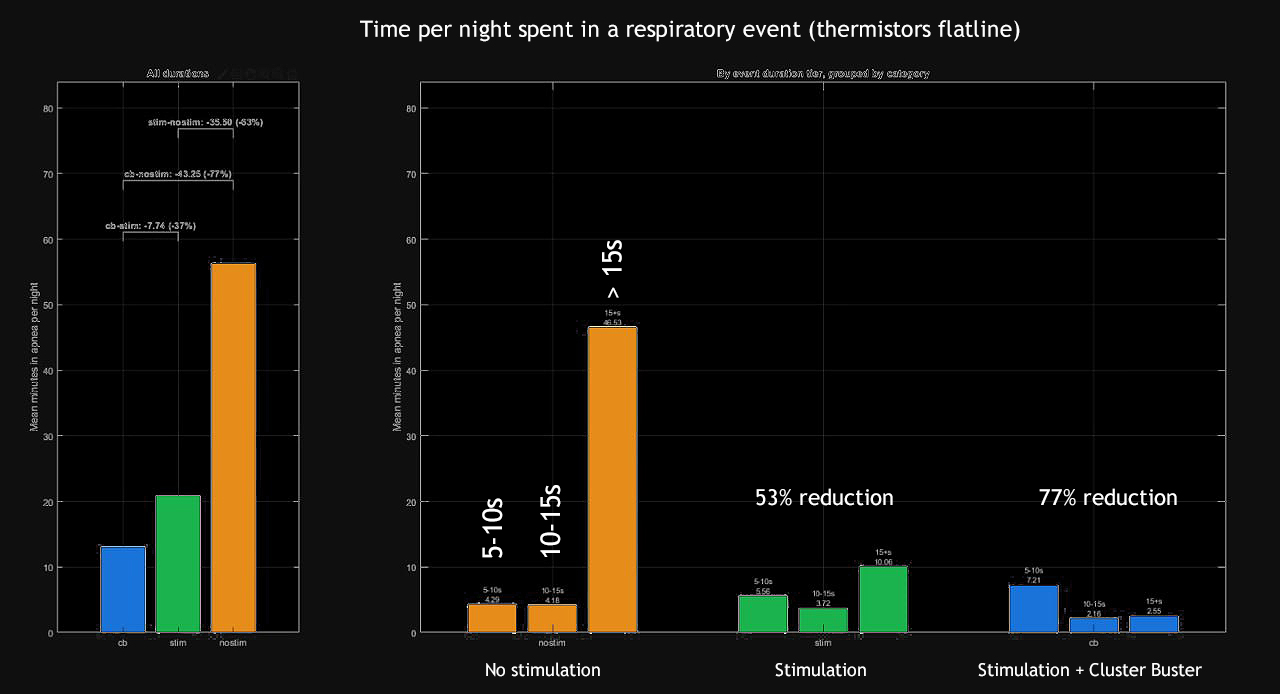
Regular stimulation can cut respiratory events short, leading to an almost complete
removal of events longer than the detection window of 5 seconds. However, events will continue to occur freely.
Cluster Buster stimulates upon detection of a respiratory event cluster, requiring a small position change.
After the position change, clusters are frequently terminated, leading to an actual reduction of the
number of events, not just their total cumulative time.
The Total version of AirMax outputs data in plain EDF file format. EDF data can be opened with any EDF viewer, or with
widely available libraries in Python, C#, Matlab etc. Additionally the exported data is fully compatible with
Hypnodyne's HDScorer software, for easy visualization of event markers, stimulation markers, and on-the-fly recalculation of the night
for fine tuning detection settings.
Precision
SpO2 calculation is extremely sensitive to
distortions in the shape of the PPG waveform. Most devices use a
strong low-pass filter as a quick and simple solution. However,
this approach has significant side effects. First, the
desaturation signal can lag by up to 20 seconds. Second,
filtering raises the minimum SpO2 value, resulting in a
significant underestimation of the true desaturation.
With biosignals, analyzing artifact-
free data is relatively easy. Identifying and rejecting
artifacts, however, is much more challenging, as their morphology
and characteristics can vary widely.
AirMax utilizes a number of custom algorithms to analyze the behavior of the PPG
signal, reject malformed peaks, and identify unreliable SpO2 values. This means
that AirMax SpO2 data is unfiltered, with a temporal resolution and lag
of exactly one heartbeat.
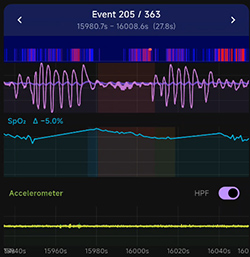
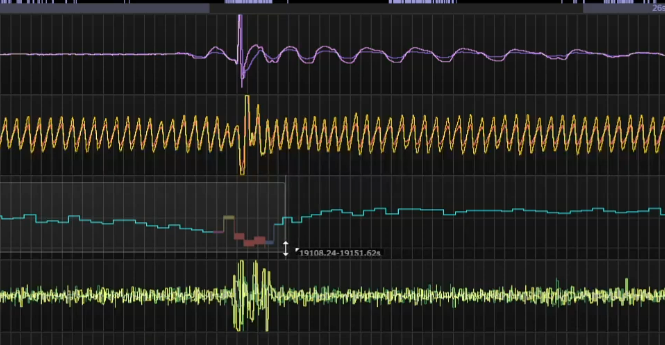
During recovery from a desaturation, there may be only one or two heartbeats
with a clean PPG waveform. These peaks can contain the true minimum SpO2 value
for the event. AirMax can capture this value due to the precision of its analysis.
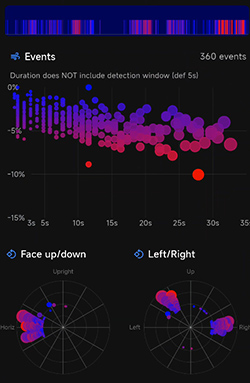
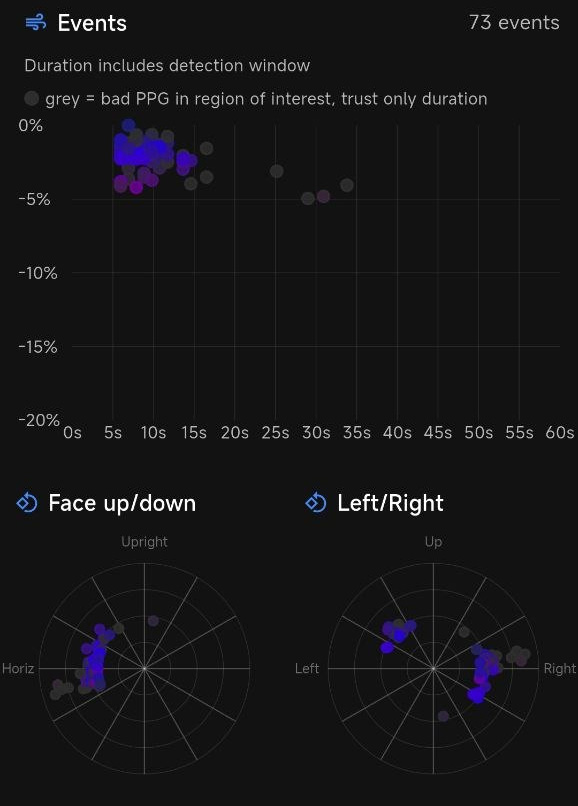
A confidence metric is provided for each event. Low-confidence events—with a
trusted duration but an untrusted desaturation value—are shown in grey. The
amount of 'grey' visible during a night also provides an indication of device-
wearing quality: the better the sensor contact with the nostrils, the less PPG
distortion occurs during each recovery, and the less grey appears on the chart.
Why AirMax?
Miniaturized & Easy to Wear: Lightweight, non-intrusive design fits over the nose for effortless overnight use.
Multi-Sensor Precision: Measures airflow, SpO₂, movement, head tilt, and sound for a complete picture of sleep physiology.
Objective Data Collection: Captures breathing patterns, oxygen variability, snoring, restlessness, and environmental disturbances - data STOP-BANG and questionnaires can't provide.
Scalable for Research: Ideal for perioperative, cardiovascular, metabolic, sleep, and population studies - works in labs, at home, or multi-site protocols.
Easy Data Access & Sharing: EDF file format compatible with Python, Matlab, C#, and can be shared via phone apps instantly.
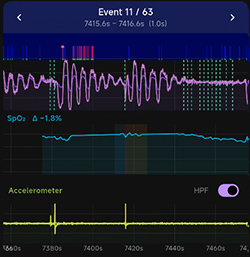
While holding your breath with the airway open, small pulses caused by each heartbeat can be seen.
Breath holding – cardiogenic oscillations absent
When the glottis is voluntarily closed, these heartbeat-related airflow pulses disappear.
Mouth breathing:
During mouth breathing, a regular airflow signal can still be detected at the nostrils.
Use cases
Many clinical and research protocols use the STOP-BANG questionnaire to quickly flag participants at elevated risk for obstructive sleep apnea (OSA). STOP-BANG works because it is simple, validated, and easy to deploy at scale. Its limitation is equally well understood: it provides risk classification, not physiological evidence.
AirMax enables researchers to collect continuous, objective
respiratory related signals that are not captured by
questionnaire-based screening tools such as STOP-BANG, including
event counts, oxygen saturation trends, temporal patterns, and
night-to-night variability.
Perioperative and anesthesia research: AirMax can be used to explore relationships between overnight respiratory physiology and postoperative observations in research settings, supporting hypothesis generation beyond self-reported risk scores.
Cardiovascular and metabolic research: Quantitative physiological features (e.g., oxygen saturation dynamics, breathing pattern variability) can be analyzed alongside cardiometabolic variables to investigate associations in observational studies.
Sleep and population-based studies: Wearable-derived data supports large-scale data collection and exploratory phenotyping in research cohorts, reducing reliance on resource-intensive laboratory studies.
Large or at-home research cohorts: AirMax provides a scalable, low-burden method for collecting longitudinal physiological data to complement existing screening instruments.
Studies incorporating STOP-BANG: AirMax does not replace questionnaires or redefine risk classification. Instead, it provides independently measured physiological data that may be used for validation analyses, subgroup exploration, and data-driven interpretation within research protocols.
Easy file sharing
In the morning, AirMax data can be easily shared using any app on your phone (e.g., email, WhatsApp, Telegram, etc.).
ZMax sync
AirMax respiration data can be synced to real time EEG data collected with ZMax Total.
For now, this requires ZMax Total to be running in wireless mode, so that packet timing can be shared. In the future
some way of synchronizing AirMax and ZMax Lite data will be provided, albeit with some user input and not fully automated.
Availability
The first prototypes of AirMax are available.
We will ship initial prototypes on a first come, first served basis. The order page is here.




 During recovery from a desaturation, there may be only one or two heartbeats
with a clean PPG waveform. These peaks can contain the true minimum SpO2 value
for the event. AirMax can capture this value due to the precision of its analysis.
During recovery from a desaturation, there may be only one or two heartbeats
with a clean PPG waveform. These peaks can contain the true minimum SpO2 value
for the event. AirMax can capture this value due to the precision of its analysis.


